 | (left) Invariant mass of the $\Lambda\mu^+\mu^-$ system in the $15 < q^2 < 20$ GeV$^2/c^4$ interval with the fit function overlaid. (right) Measured differential branching fraction of the rare $\Lambda_b^0 \rightarrow \Lambda \mu^+ \mu^-$ decay as a function of $q^2$ with the SM prediction~\protect\cite{prediction} superimposed. The inner error bar on data points represents the total uncertainty on the relative branching fraction (statistical and systematic); the outer error bar also includes the uncertainties from the branching fraction of the normalisation mode. |
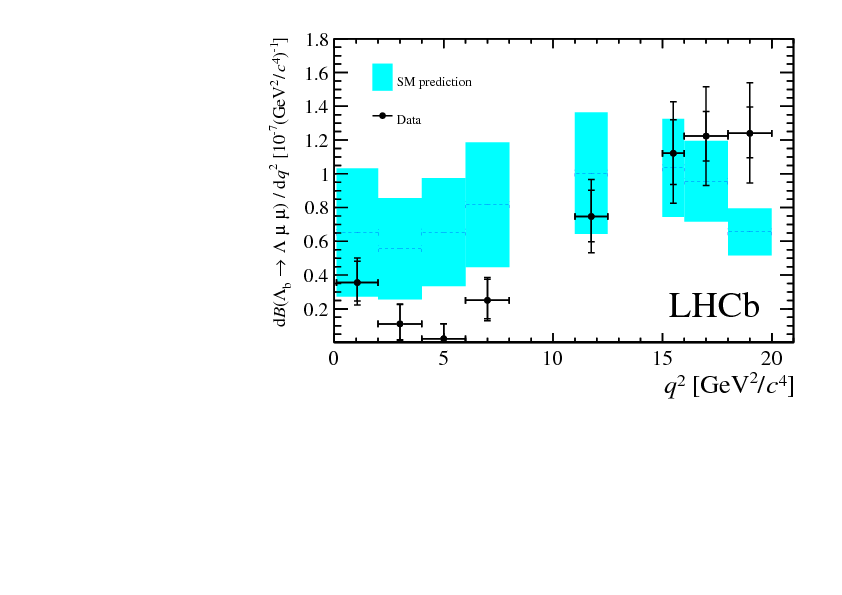 | (left) Invariant mass of the $\Lambda\mu^+\mu^-$ system in the $15 < q^2 < 20$ GeV$^2/c^4$ interval with the fit function overlaid. (right) Measured differential branching fraction of the rare $\Lambda_b^0 \rightarrow \Lambda \mu^+ \mu^-$ decay as a function of $q^2$ with the SM prediction~\protect\cite{prediction} superimposed. The inner error bar on data points represents the total uncertainty on the relative branching fraction (statistical and systematic); the outer error bar also includes the uncertainties from the branching fraction of the normalisation mode. |
 | Distributions of the (left) $\cos \theta_\ell$ and (right) $\cos \theta_h$ angles in data in the $15 < q^2 < 20$ GeV$^2/c^4$ interval with overlaid the total fit function, solid (blue) line, and the background component, dashed (red) line. |
 | Distributions of the (left) $\cos \theta_\ell$ and (right) $\cos \theta_h$ angles in data in the $15 < q^2 < 20$ GeV$^2/c^4$ interval with overlaid the total fit function, solid (blue) line, and the background component, dashed (red) line. |
 | Forward-backward asymmetries as a function of $q^2$ in the dimuon system (left) and $p\pi^{-}$ system (right) with the SM prediction~\protect\cite{prediction} overlaid. |
 | Forward-backward asymmetries as a function of $q^2$ in the dimuon system (left) and $p\pi^{-}$ system (right) with the SM prediction~\protect\cite{prediction} overlaid. |