Color-Kinematics Duality for QCD Amplitudes
- Johansson, Henrik et al
- arXiv:1507.00332CERN-PH-TH-2015-149UUITP-13-15NORDITA-2015-79EDINBURGH-2015-11
 | \small Color vertices with planar ordering consistent with the color-stripped Feynman rules. |
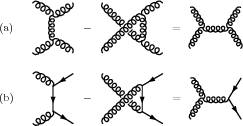 | \small Color-algebra relations in the adjoint~(a) and fundamental representation~(b). The color-kinematics duality requires that the kinematic numerators satisfy the corresponding kinematic-algebra relations, which can be represented by the same graphs. |
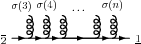 | \small Multi-peripheral cubic diagram for the color factors in formulas~\eqref{QuarkLineDecomposition} and~\eqref{DDM}. All permuted legs are gluons, while the horizontal line can be either a quark or a gluon line. |
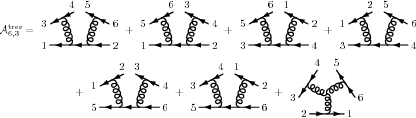 | \small Feynman diagrams for the six-quark amplitude ${\cal A}^{\text{tree}}_{6,3}(\u{1},\o{2},\u{3},\o{4},\u{5},\o{6})$. |
 | \small Feynman diagrams for the four-quark one-gluon amplitude ${\cal A}^{\text{tree}}_{5,2}(\u{1},\o{2},\u{3},\o{4},5)$. |
 | \small Diagrammatic form of the operator $\Xi^a_l$. It is drawn as a single diagram with hollow quark-gluon vertices, this represents summation over the possible locations where the gluon line can attach. |
 | \small Diagrammatic representation for the color coefficient of the planar amplitude $A(\u{1},\o{2},13,\u{3},\u{5},\o{6},\o{4}, \u{7},\u{9},14,\u{11},\o{12},\o{10},\o{8})$, obtained by using the notation of \fig{fig:Xi}. Note that the diagram has the same structure as the word $\{2\:13 \{ 3 \{5\:6\} 4 \} \{ 7 \{ 9\:14 \{11\:12\} 10 \} 8 \} 1\}$. |